Latihan Soal Bahasa Inggris
Tes Kemampuan Akademik (TKA) SMA — 30 soal keterampilan membaca dalam bahasa Inggris yang menguji pemahaman tekstual, pemahaman inferensial, serta evaluasi dan apresiasi atas teks informasi tunggal, teks jamak, infografis, dan teks fiksi.
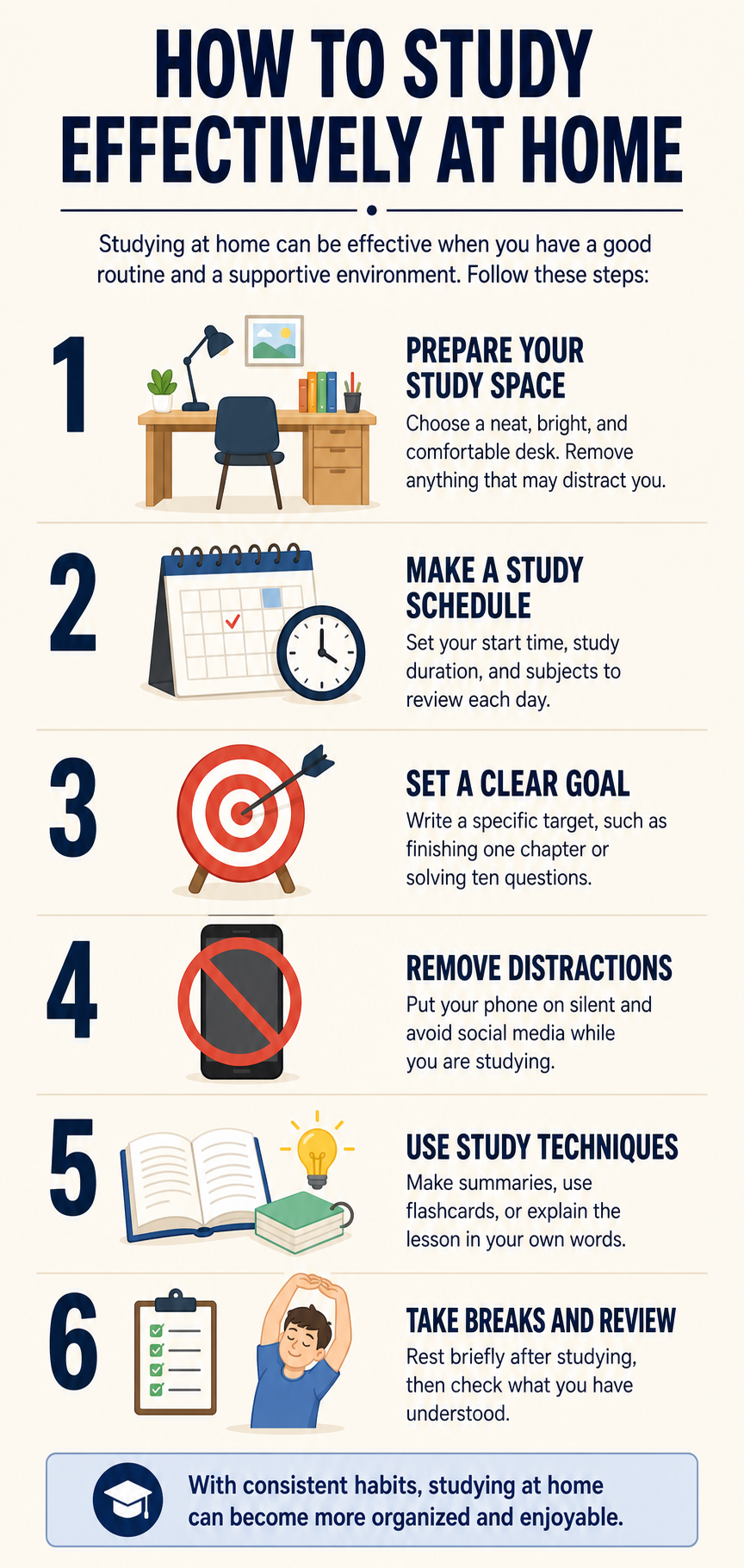
Infographic Information — How to Study Effectively at Home: Studying at home can be effective when you have a good routine and a supportive environment. Follow these steps: (1) Prepare your study space — choose a neat, bright, and comfortable desk; remove anything that may distract you. (2) Make a study schedule — set your start time, study duration, and subjects to review each day. (3) Set a clear goal — write a specific target, such as finishing one chapter or solving ten questions. (4) Remove distractions — put your phone on silent and avoid social media while you are studying. (5) Use study techniques — make summaries, use flashcards, or explain the lesson in your own words. (6) Take breaks and review — rest briefly after studying, then check what you have understood. With consistent habits, studying at home can become more organized and enjoyable.
| No. | Pernyataan | BENAR | SALAH |
|---|---|---|---|
| A | The infographic suggests choosing a neat, bright, and comfortable desk. | ||
| B | The infographic asks students to study continuously without taking breaks. | ||
| C | Making summaries and using flashcards are recommended as study techniques. |
Lok Baintan Floating Market
About thirty minutes from the center of Banjarmasin, a small river splits into narrow waterways where hundreds of small boats gather every morning. This place is Lok Baintan, a floating market that has become part of daily life for people living along the Barito River. Unlike an ordinary market, there is no land, no building, and no parking area here. Everything happens on the water.
The market starts very early, around five o'clock, when the sky is still dark. Sellers and buyers arrive in long, narrow boats called kelotok. A trader's boat is easy to recognize. It is full of colorful piles of fruit and vegetables: bananas, rambutans, tomatoes, water spinach, and sweet potatoes. Many sellers also bring homemade snacks, coconut sugar, and roasted fish wrapped in banana leaves. A buyer usually approaches another boat slowly, holds the edge of it, and starts to bargain with a smile.
The most interesting moment is the barter tradition between traders. When two boats meet, the sellers often exchange their goods directly: a basket of rambutans for a bag of vegetables, for example. Nobody counts the exact price; they only compare the size of each pile. This habit has continued for generations, and it keeps the atmosphere of the market warm and friendly.
The market usually becomes quiet at about eight o'clock, when the sun gets higher and the customers go home. Then the boats leave the waterway one by one, leaving only the sound of engines and the smell of the river. For local people, Lok Baintan is not only a place to trade. It is a meeting point, a tradition, and a picture of how life on the river has remained almost the same for hundreds of years.
| No. | Pernyataan | BENAR | SALAH |
|---|---|---|---|
| A | The traders at Lok Baintan always count the exact price when they barter. | ||
| B | The sellers bring fruit, vegetables, homemade snacks, and roasted fish to the market. | ||
| C | The market usually becomes quiet at about eight o'clock in the morning. |
A Beach Clean-Up with My Class
Last month, my classmates and I joined a beach clean-up at Batakan Beach. Our science teacher, Mr. Hasan, organized the activity after we learned about plastic waste in the ocean. We left the school at six in the morning by bus, and we arrived at the beach before seven.
When we got there, the beach looked beautiful, but we were surprised by what we found between the rocks. There were plastic bottles, plastic bags, snack wrappers, and even an old fishing net. Mr. Hasan divided us into five groups and gave each group gloves, rakes, and large sacks.
My group worked near the food stalls. At first, picking up dirty waste felt strange and tiring. However, after an hour, we enjoyed the work. We made a competition to see which group could collect the most bottles. My friend Dita won because she found a big plastic container behind a rock. A local seller was happy with us and gave our group free glasses of iced tea.
By noon, we had filled more than twenty sacks of rubbish. The beach looked clean and wide again. Before we went home, we took a photo together in front of the sacks. On the way back to school, I felt tired but proud. That day I learned that keeping the environment clean is easy to start, but it needs everyone to help.
The Little Owl's Contest
In a green valley between two mountains, there lived a little owl named Olin. Unlike other owls, Olin did not enjoy the night. She loved the morning, when the sky turned gold and the whole valley woke up. Every sunrise, she sat on the tallest branch and listened to the birds singing together. Their songs were bright and cheerful, and Olin wished she could sing like them.
One morning, the birds announced a singing contest for the best voice in the valley. Olin wanted to join, but the sparrows laughed at her. "Owls sing at night, and their voices are sad," they said. "You will make the morning gloomy." Olin almost gave up, but an old dove whispered, "Do not borrow their doubt. Bring what you have."
Olin practiced for many nights in secret. Her voice was soft and low, very different from the sparrows' sharp songs, so she decided not to fight against it. On the day of the contest, she sang a slow, gentle melody about the valley sleeping under the stars. The morning became so quiet that even the wind stopped to listen. When she finished, nobody laughed. The judges, three old eagles, gave her the first prize, not because her voice was the loudest, but because her song was honest and calm.
The sparrows felt ashamed and asked for her forgiveness. Olin only smiled and invited them to sing together. From that day, every sunrise in the valley began with a low owl voice and bright sparrow songs, one after another, like a beautiful conversation. The valley finally understood that a different voice does not ruin the music; it makes the song complete.
| No. | Pernyataan | BENAR | SALAH |
|---|---|---|---|
| A | Olin practiced her song in secret for many nights. | ||
| B | The song that made Olin win was about the valley sleeping under the stars. | ||
| C | At the end of the story, the sparrows refused to sing together with Olin. |
The Invention of Instant Noodles
Instant noodles are among the most popular foods in the world, but they are actually a fairly young invention. The story began in Japan after the Second World War. At that time, Japan suffered from a serious food shortage, and people had to stand in long lines to buy bread made from imported flour. A businessman named Momofuku Ando believed that a supply of noodles would be a better solution, because Japanese people were already familiar with noodles.
In 1958, Ando started working in a small shed in his garden. He wanted to create noodles that anyone could cook quickly at home. For months, he tried many methods, but the noodles always lost their springy texture. One night, after watching his wife cook tempura, he noticed that frying removed the water from food. This gave him an idea: he fried the noodles to remove the moisture, then dried them. The result was a block of noodles that stayed fresh for months and became ready to eat after hot water was poured over it.
Ando named his product Chicken Ramen, and it soon spread to shops across Japan. Interestingly, the price of the first product was higher than a bowl of fresh noodles at restaurants, yet people still welcomed it. In 1971, he introduced another innovation: instant noodles in a small cup, complete with a plastic fork. The cup noodles made the food even more practical for travelers, students, and office workers. Today, people around the world consume billions of portions of instant noodles every year. Ando's simple idea, born in a garden shed, has become one of the greatest conveniences of modern life.
How to Make a Simple Omelette
An omelette is one of the easiest dishes that anyone can cook. It is cheap, quick, and healthy, so many people choose it for breakfast before school or work. You only need two eggs, a pinch of salt and pepper, one tablespoon of cooking oil, and any filling you like, such as chopped tomato, onion, or grated cheese. You will also need a frying pan, a bowl, a fork, and a spatula.
To make it, first break the eggs into a bowl. Add the salt and pepper, then beat the eggs with a fork until the yolk and the white mix well. If you use onion or tomato, put them into the mixture now. Next, heat the oil in a frying pan over medium heat. When the pan is hot, pour in the egg mixture slowly. Let it cook for about two minutes. When the bottom becomes light yellow and the top is still a little wet, add the cheese if you like. After that, fold the omelette in half with the spatula and cook it for one more minute. Finally, move the omelette to a plate and enjoy it while it is warm.
Remember not to use heat that is too high, because it will burn the bottom before the inside is cooked.
Why Students Should Join School Organizations
Many students think that school organizations only waste their time. In fact, joining an organization such as the student council, a science club, or a scout unit is one of the best decisions a student can make. I personally believe that every student should join at least one school organization during their senior high school years.
First, organizations train students to manage their time. A member of the student council, for example, has to attend meetings, prepare events, and still finish the homework. Because of this routine, students learn to arrange a schedule and avoid wasting hours on useless activities. This skill will be very useful when they continue to university or start working.
Second, school organizations develop soft skills that classrooms cannot fully give. When students organize a bazaar or a camping activity, they practice how to communicate, negotiate, and lead a team. They also learn to accept different opinions and to solve problems calmly when a plan does not run well. These abilities are exactly what companies look for in their future employees.
Finally, organizations widen students' friendship networks. Members meet schoolmates from other classes and levels who share the same interest. This network often becomes a source of motivation, information about scholarships, and even job opportunities years after graduation.
Some people argue that organizations distract students from their study. However, research shows that students who are active in organizations usually manage their study better, because they have clear goals and disciplined habits. Based on the arguments above, it is clear that joining a school organization brings more benefits than harms. Therefore, every student should stop seeing organizations as a burden and start seeing them as a real preparation for life.
| No. | Pernyataan | BENAR | SALAH |
|---|---|---|---|
| A | The writer thinks that school organizations only waste students' time. | ||
| B | Students who are active in organizations usually manage their study better. | ||
| C | Companies rarely need the soft skills that organizations train. |
| No. | Pernyataan | BENAR | SALAH |
|---|---|---|---|
| A | The text suggests that students join organizations after they enter university. | ||
| B | According to the text, communication skills can be fully learned in classrooms. | ||
| C | School organizations can be a source of information about scholarships. |
Teks 6A — Cashless Canteens
Many senior high schools in big cities have started to use cashless payments in their canteens. Students do not need to bring cash; they simply scan a QR code or tap a student card, and the money is taken from their digital balance. The canteen sellers say the system makes their work faster because they no longer need to look for change. The school also finds it easier to record daily transactions. However, not all students are happy. Some of them feel that spending becomes harder to control. When they use an application, they cannot see the money physically leave their wallet, so they often spend more than they plan. Because of that, several schools now display a weekly spending report for each student, hoping the report will help the students manage their money better.
Teks 6B — A Comment on the School Web Forum
I have used a student card for two semesters, and honestly, I like it. First, it is safe. I remember losing my cash twice in one semester, but a card can be blocked if it is lost. Second, the application records everything. Last month, I checked my history and found that I spent too much on sweet drinks. Since then, I have reduced my snacks and saved around fifty thousand rupiahs a week. In my opinion, the problem is not the cashless system, but the habit of the users. If students check their spending report regularly, a cashless canteen actually teaches them to be more disciplined with money.
| No. | Pernyataan | BENAR | SALAH |
|---|---|---|---|
| A | Some schools display a weekly spending report to help students manage their money. | ||
| B | Text 6B states that the cashless system is the main cause of students' bad spending habits. | ||
| C | The writer of Text 6B suggests blocking the canteen application at school. |
The Komodo Dragon
The Komodo dragon is the largest lizard in the world. It lives naturally in Indonesia, especially on Komodo Island, Rinca Island, and several small islands around them. Because of its unique size, the Indonesian government protects this animal, and UNESCO has made its home a national park.
An adult Komodo dragon can reach more than three meters long and weigh around one hundred kilograms. Its body is covered with thick, dry scales that look like small stones. The color is usually grey-brown, which helps the animal hide among the rocks and dry grass. It has short, strong legs, a long heavy tail, and about sixty sharp, curved teeth.
Komodo dragons are mostly hunters, but they also like to eat dead animals. They hunt deer, wild pigs, and birds. Interestingly, their bite is special. Their saliva contains dangerous bacteria, and their lower jaw produces a poison that stops the blood from clotting. One bite is usually enough, because the prey will become weak and fall in a short time.
These giant lizards are generally quiet during the hottest part of the day. They like to rest under trees or in holes that they dig in the ground. Sadly, the number of Komodo dragons in the wild is decreasing. Scientists worry that rising sea levels and changing weather may reduce their small habitat even more. For this reason, people around the world continue to support the protection of this ancient animal.
How to Create a Strong Password
Almost everything we do online needs a password: school accounts, social media, games, and online shops. Unfortunately, many people still use simple passwords such as "123456" or their own birth date, and this habit makes their accounts easy to break. Follow these steps to create a password that is strong and easy for you to remember.
First, make your password long. Use at least twelve characters, because the longer a password is, the harder it is to guess. Second, mix different types of characters: capital letters, small letters, numbers, and symbols. For example, instead of "ilovebasketball", write "iLov3B@sketb@ll!". Third, do not use personal information. Other people can find your name, your birthday, and your favorite team on your social media, so avoid all of them.
Next, use a different password for every important account. If a thief steals the password of your game account, your school account and your parents' online banking will remain safe. To remember many passwords, you can use a short sentence and change some letters into numbers or symbols. For example, "My cat eats 2 fish every day!" becomes a strong and memorable password.
Finally, change your important passwords every six months, and never share them with anybody, not even your best friends. If you write them down, keep the notes in a safe place at home.
| No. | Pernyataan | BENAR | SALAH |
|---|---|---|---|
| A | Using your birth date as a password is a safe choice. | ||
| B | A password made of only small letters is the hardest to guess. | ||
| C | Sharing your passwords with your best friends keeps your accounts secure. |
The Old Bicycle
Rina had walked four kilometers to school every day for two years. Her village was small, and the road was long and dusty. She never complained, but her father felt sad about it. As a fisherman, he did not have much money, and a bicycle cost almost two months of his income.
One afternoon, Rina found an old, rusty bicycle behind her uncle's warehouse. Two tires were flat, the chain was stiff, and the seat was torn. Her uncle laughed when she asked about it. "That thing has not moved for ten years," he said. "If you can make it run, it is yours." Rina took the challenge seriously.
Every day after school, she cleaned the bicycle behind the house. She saved her pocket money to buy oil and two new inner tubes. When she did not understand something, she asked the repairman near the market, Pak Darto, who was happy to teach her. Sometimes her hands smelled of rust and oil, and her mother complained about the dirty floor. Rina did not care. After six weeks, she rubbed oil on the stiff chain, pumped the tires, and rode the bicycle slowly around the yard. It moved! It was ugly, noisy, and slow, but it moved.
The next Monday, Rina rode her old bicycle to school for the first time. Her classmates gathered around it, and some of them laughed at its rusty frame. Rina only smiled. "It is not beautiful," she said, "but it carries my effort." At the end of the semester, the school principal praised her story in front of all students. He reminded everyone that valuable things do not always look perfect; sometimes they are built with patience, sweat, and a little oil.
| No. | Pernyataan | BENAR | SALAH |
|---|---|---|---|
| A | Rina cleaned and repaired the old bicycle every day after school. | ||
| B | Pak Darto, the repairman, taught Rina when she did not understand something. | ||
| C | The principal used Rina's story to remind the students about the value of effort. |
Sudah Selesai Berlatih?
Lihat hasil latihanmu, pelajari kembali pembahasan soal yang salah, lalu lanjutkan ke paket lainnya.